Card issuance has been one of the most stable and profitable drivers of the financial system, thanks to the ongoing need to connect users within the ecosystem to their financial services, streamlining the delivery of benefits and enabling payments, purchases, and account inquiries at any time. In this regard, credit, debit, and prepaid programs have not only driven financial inclusion but have also become a central pillar of the relationship between banks and their customers.
However, the environment in which financial institutions operate today is radically different from that of ten or fifteen years ago. The expansion of digital payments, the emergence of new fintech players, the proliferation of digital wallets, and the growth of e-commerce have transformed the way payment methods are designed, issued, and used.
In this new context, many institutions are facing a structural challenge: their card management platforms were designed for a financial ecosystem that has changed rapidly, with some platforms no longer supported or having simply disappeared.
Traditional Card Management Systems (CMS) were designed to operate in relatively stable environments, with gradual changes and closed technological architectures. Today, however, banks need to operate in highly dynamic ecosystems, where the speed of innovation, interoperability, and adaptability are key factors.
Modernizing card management infrastructure is no longer just a technological decision; it has become a strategic decision for the competitiveness of the payments business.
The Burden of Legacy Infrastructures
One of the main challenges facing financial institutions is their reliance on legacy systems to manage their card programs.
In many cases, these systems were implemented decades ago and have evolved through multiple layers of customization, ad-hoc integrations, and specific developments. Although they have proven to be stable platforms, they also have limitations that are becoming increasingly evident in today’s environment.
One of the primary constraints lies in the capacity for innovation. Launching a new card product, making changes to rule configurations, or enabling new features can involve long and complex, and even prohibitive, development cycles. This slows down institutions’ ability to respond to market demands.
Another critical issue is integration with the digital ecosystem. Today, card programs must interact with multiple players: fintechs, wallets, processors, payment networks, e-commerce platforms, and digital services. Legacy architectures, originally designed as closed systems, often require costly development to enable these connections.
Added to this is operational scalability. As transaction volumes increase and payment channels multiply, traditional systems can become a bottleneck for growth.
The result is a paradox: while the payments business becomes increasingly dynamic, many institutions continue to operate with infrastructures that hinder their ability to evolve.
More Than Just Card Management
In the past, the primary goal of a CMS was to manage the card lifecycle: issuance, activation, limit management, transaction processing, and settlement. Today, that function remains essential, but it is no longer enough.
Banks need platforms capable of integrating with complex digital ecosystems and enabling new business models. This means that the CMS must evolve from an isolated system into a central component within the institution’s payments architecture.
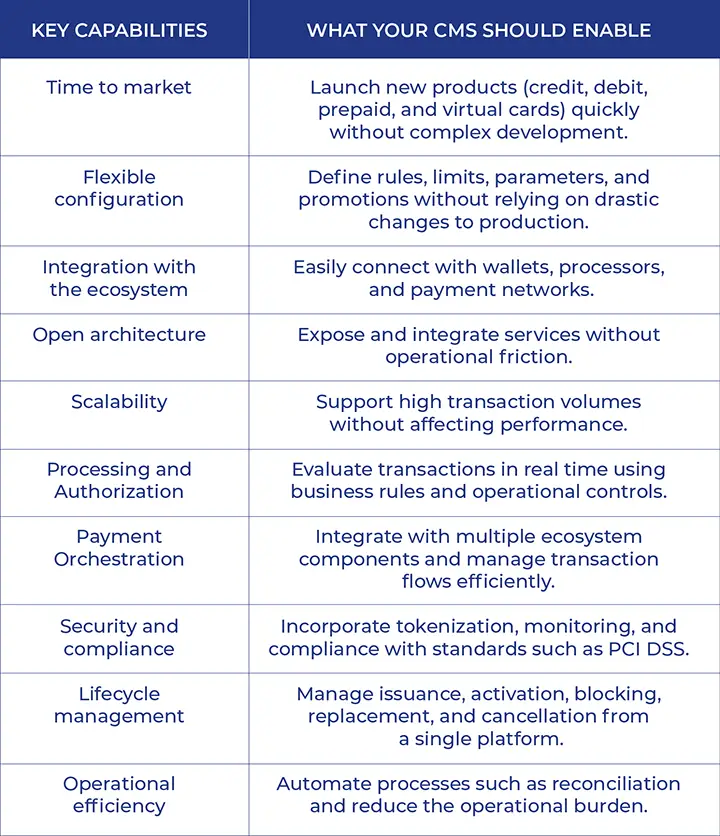
Instead of merely managing cards, modern systems allow for the configuration of dynamic rules, the launch of new card issuance programs, the integration of external services, and the management of multiple types of payment methods from a single platform.
This evolution reflects a profound shift in how financial services are conceived. Payment methods are no longer merely transactional tools; they have become platforms for financial interaction that connect merchants, consumers, institutions, and technology providers.

The Role of a Modern CMS in the Payments Ecosystem
A modern Card Management System must be capable of operating within an open and constantly evolving ecosystem. This involves adopting more flexible architectures based on principles such as modularity, interoperability, and integration capabilities.
These platforms enable institutions to:
- Launch new card programs more quickly.
- Integrate third-party services without complex development.
- Manage multiple products from a single infrastructure.
- Scale operations as transaction volumes grow.
- Maintain control over configurations, rules, and security.
But beyond technical capabilities, the true advantage of a modern CMS is that it reduces the operational friction that has historically limited innovation in the card business.
When technology infrastructure ceases to be an obstacle, institutions can focus on designing new products, exploring strategic partnerships, and expanding their financial services offerings.
Is your Card Management System ready to help your business grow?
From Issuance to Orchestration
One of the most significant transformations in the payments industry is the shift from models focused solely on issuance to payment orchestration architectures.
In these models, the CMS integrates with multiple components of the financial ecosystem to coordinate different processes within a single technological infrastructure, including connections to payment networks, processors, anti-fraud systems, tokenization platforms, digital wallets, and financial service providers. It takes alternative routes and sends information simultaneously to establish security, authenticity, and basic customer response rules—without exceeding industry-standard processing times—while dynamically strengthening the authentication and availability processes for each transaction.
Orchestration enables institutions to manage these elements from a unified architecture, reducing integration complexity and increasing operational efficiency. In this context, Card Management System solutions such as EVERYCARD® have been designed to address these new market needs.
Unlike traditional systems, EVERYCARD® enables financial institutions to manage their card issuance, integrate payment ecosystem services, and maintain operational control within a flexible and scalable architecture.
This approach facilitates the transition from models focused exclusively on issuance to infrastructures capable of supporting payment orchestration within increasingly interconnected financial environments.

Preparing the Infrastructure for the Next Generation of Payments
The transformation of the financial ecosystem will continue to accelerate in the coming years. The adoption of digital payments, the expansion of fintech models, and the growing demand for more agile financial experiences will continue to drive change in the industry.
In this scenario, technology infrastructure becomes a critical factor for competitiveness.
Institutions that continue to operate with rigid architectures will face greater difficulties in innovating and adapting to new market dynamics.
In contrast, those that modernize their Card Management System will be able to build payment ecosystems that are more flexible, interoperable, and ready to evolve.
Ultimately, modernizing your CMS isn’t just about updating technology. It’s about building a platform capable of supporting the long-term growth, innovation, and security of your payments business.
If you’d like to modernize your CMS with EVERYCARD®, please fill out the form below, and a dedicated representative will contact you.