Across nearly every city in Latin America, the same scene plays out: someone pays for coffee using a digital wallet or an instant transfer from their phone. Minutes later, another customer makes a purchase with a card. Further down the road, someone withdraws cash from an ATM before visiting a merchant that still does not accept digital payments.
All three transactions take place on the same day. All three are part of the same financial system, yet they rely on entirely different infrastructures.
In recent years, the payments conversation has centered on a recurring idea: cash is losing share. International reports consistently show that digital wallets, account-to-account transfers and mobile payments continue to gain ground, while cash is gradually becoming less prominent in consumer transactions.
While accurate, that conclusion overlooks a far more important question for financial institutions:
What happens to the infrastructure that continues to support cash as payment behaviors evolve?
Lower usage does not translate into reduced operational responsibility. ATMs must remain available, replenished and connected. Reconciliation processes must continue to run. Authorization systems must operate without interruption. Physical and digital channels must coexist, with each one adding another layer of technological complexity.
The transformation of payments is not eliminating infrastructure. It is forcing financial institutions to manage it differently.
To understand how this landscape is evolving, we analyzed official data published by central banks and financial authorities across nine Latin American markets during 2025. Rather than identifying which countries use more or less cash, the objective was to understand how transactional activity is being redistributed across cash, cards and digital channels, and what this shift means for the infrastructure supporting payments.
Far from converging on a single model, the data shows that each market is charting its own path toward payment digitalization.
Latin America Is Not Building a Single Digital Payments Model
Digitalization is often discussed as though every market were evolving at the same pace. The figures, however, reveal a far more diverse landscape.
In some countries, electronic transfers already account for most transactions. In others, debit cards remain the primary payment instrument. There are also markets where cash continues to hold a significant share despite the expansion of digital channels.
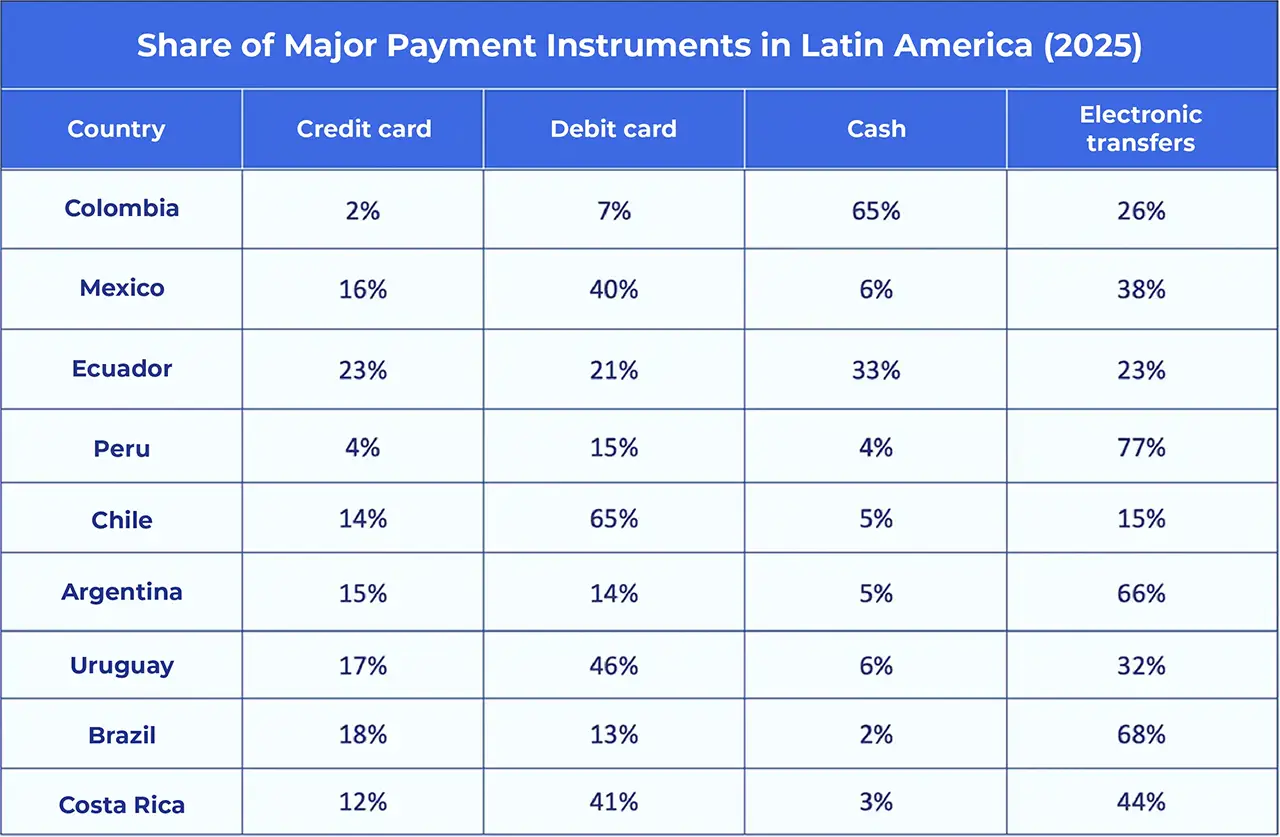
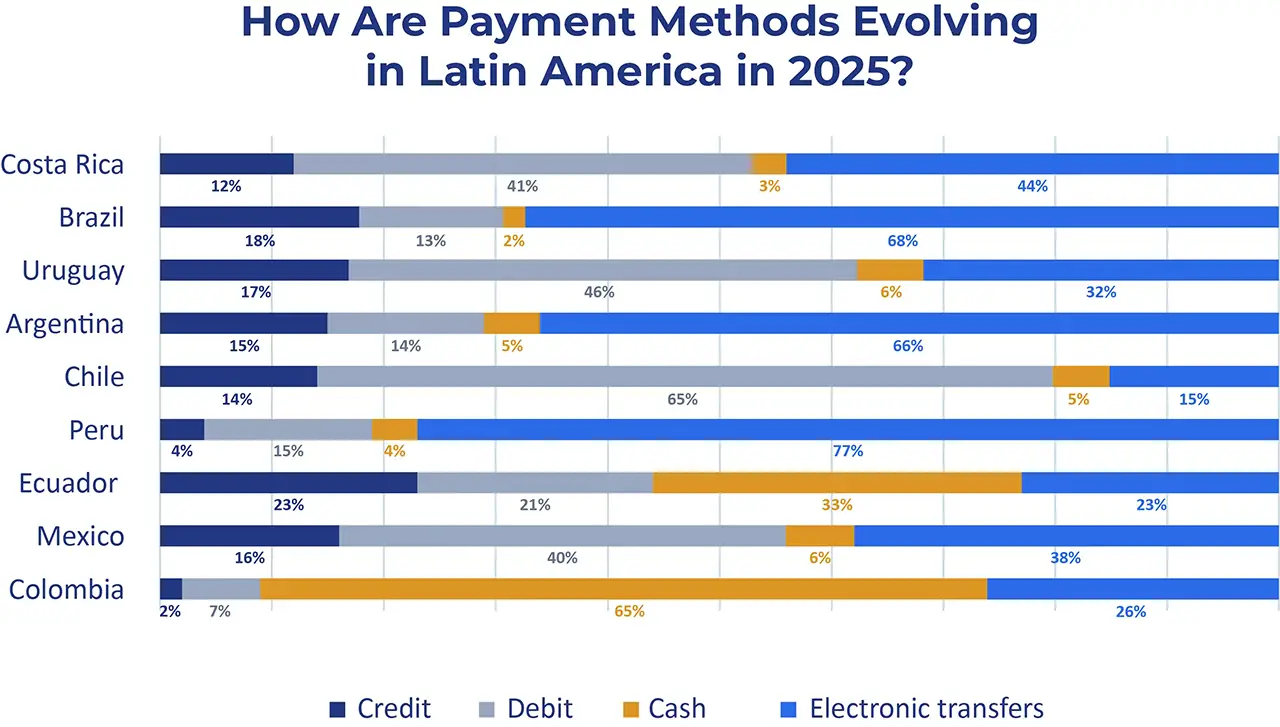
The most relevant finding is not simply that cash is losing share. What is truly revealing is that each country is managing this transition differently.
Brazil has consolidated an ecosystem in which account-to-account payments, driven by Pix, account for the largest share of transactional activity. Peru shows a similar pattern, with digital channels clearly dominating the market. Argentina also reflects a significant shift toward interoperable transfers.
Chile, by contrast, continues to rely primarily on debit cards, while Mexico shows a more balanced distribution between card payments and electronic transfers. Costa Rica presents another model: digital banking has moved slightly ahead of debit, confirming that even within the same region, there is no single transformation path.
The conclusion is clear: digitalization is advancing throughout Latin America, but at different speeds and through entirely different transactional architectures. This is precisely where the real challenge begins for financial institutions.
Cash Is Losing Share. The Infrastructure Is Not
When analyzing payment behavior, it is reasonable to conclude that cash will continue to decline as a proportion of transactions over the coming years. Global Payments Report de Worldpay, for example, identifies a sustained acceleration in digital payments worldwide, driven by digital wallets, instant transfers and new interoperability frameworks.
That trend, however, is often interpreted too narrowly. Fewer cash transactions do not automatically mean less physical infrastructure.
ATMs remain the primary point of access to cash for millions of people. Beyond supporting financial inclusion, they provide an operational continuity mechanism when other channels are unavailable and continue to play an important role in regions where digital payment acceptance remains limited.
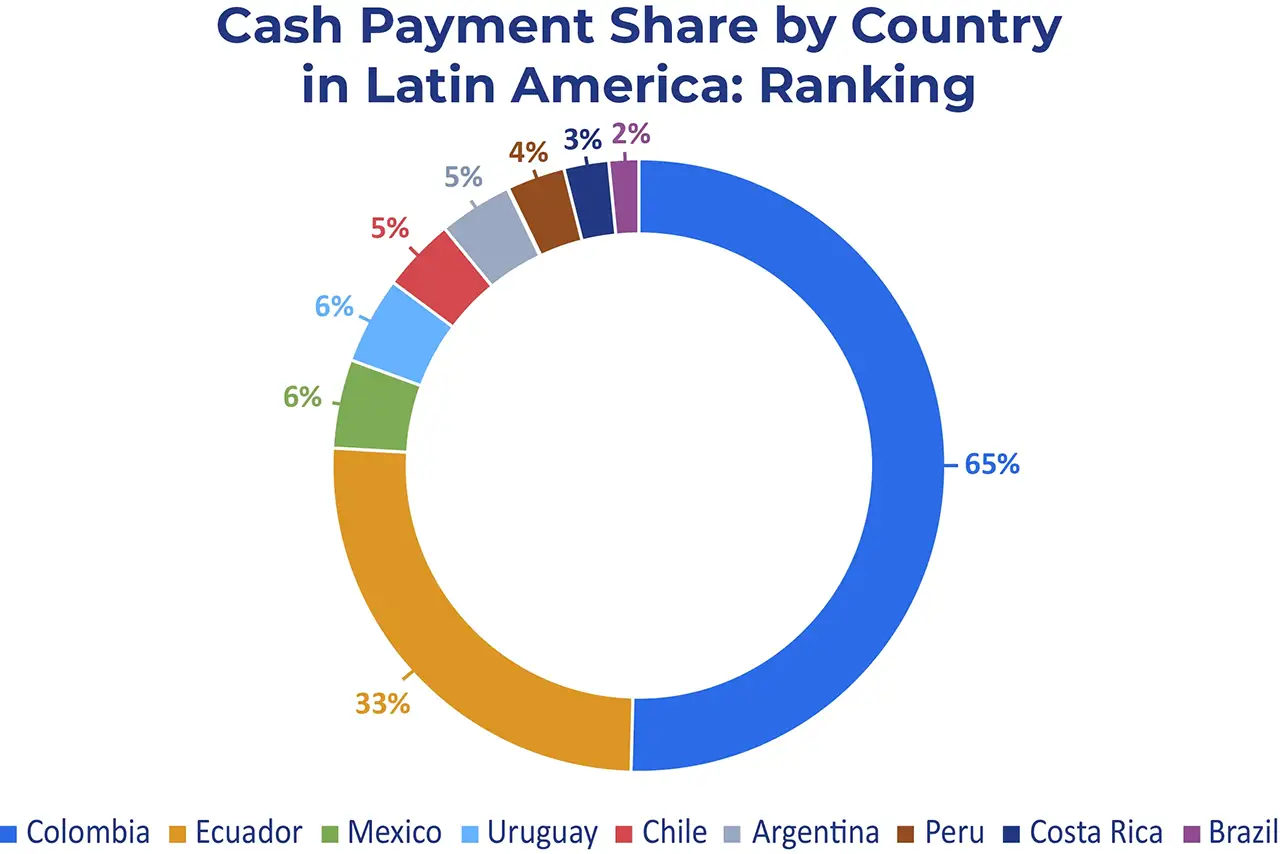
The difference between Colombia, where cash represents 65% of transactions, and Brazil, where it accounts for only 2%, demonstrates how unevenly the transition is unfolding. Yet even in markets where cash represents only a small fraction of transactional activity, the infrastructure does not disappear. What changes is how it must be managed.
Network Size No Longer Defines Efficiency
For many years, expanding an ATM network was viewed as an indicator of coverage and growth. That logic is now becoming less relevant.
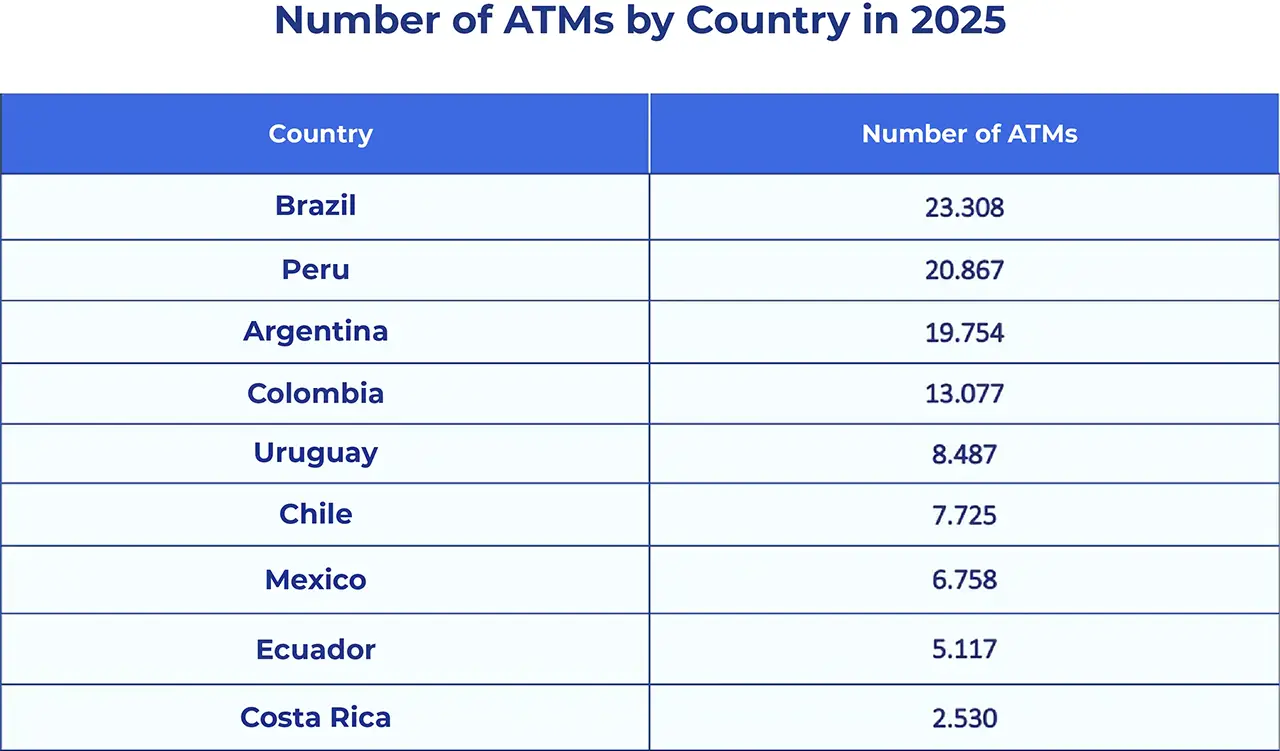
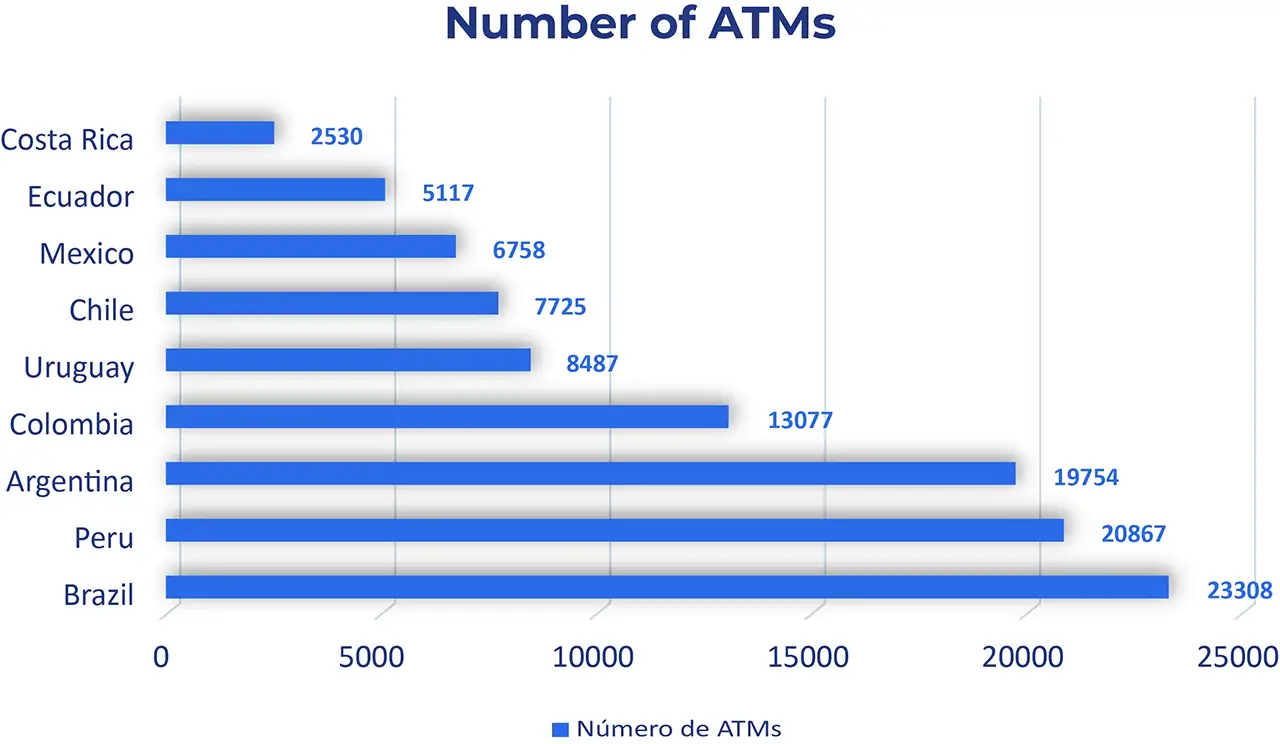
At first glance, a larger ATM network might appear to indicate greater cash usage. When both variables are compared, however, that relationship becomes far less evident.
Brazil has the largest ATM network among the markets analyzed, while also recording one of the lowest levels of cash usage. Colombia presents the opposite scenario: cash represents a significantly greater share of transactions, despite the country operating a considerably smaller network.
This demonstrates that the discussion is no longer solely about how many ATMs are available, but about how efficiently they are operated.
Every ATM carries costs related to cash replenishment, cash-in-transit services, monitoring, maintenance, availability and security. As demand changes, the infrastructure must adapt as well. This does not necessarily mean reducing the network. It means operating it more intelligently.
The Challenge Has Shifted from Technology to Operations
Payment transformation is often associated with new applications, digital wallets and instant transfers. From the perspective of financial institutions, however, the real challenge lies behind every transaction.
Each new payment instrument introduces distinct business rules, authorization processes, reconciliation mechanisms, regulatory requirements and risk profiles. As the number and diversity of channels increase, so does the complexity of coordinating the operation as a whole.
The question is therefore no longer how to add another payment method. It is how to enable every instrument and channel to coexist within a unified technology architecture without increasing operational complexity.
In this context, orchestration moves beyond being a technical capability and becomes a strategic component. The ability to integrate heterogeneous systems, establish centralized rules, route transactions intelligently and maintain visibility across the entire operation is now as important as ensuring the availability of each individual channel.
The Infrastructure of the Future Requires an Integrated View
The evolution of payment methods does not eliminate the traditional challenges facing banks. It multiplies them.
ATMs continue to coexist with cards, cards with instant transfers, and transfers with digital wallets. Every interaction generates information, rules and processes that must be coordinated in real time. This environment requires platforms capable of connecting the entire ecosystem, rather than isolated solutions designed for individual channels.
At CLAI PAYMENTS® Technologies, we approach this transformation through an integrated vision of transactional infrastructure. AZ7® enables institutions to orchestrate their operations through a centralized platform, integrating multiple channels, systems and participants, applying dynamic business rules and ensuring high availability even in highly complex environments.
This capability is complemented by EVERYCARD®, which modernizes card issuance and lifecycle management, enabling cards to continue evolving within an ecosystem where they no longer operate independently, but as part of an omnichannel strategy.
RECONPRIME® further strengthens this ecosystem by automating and centralizing transactional reconciliation processes. It provides end-to-end traceability, reduces validation times and reinforces control over data consistency across the different participants in the financial ecosystem.
The objective is not merely to process payments. It is to build infrastructure capable of issuing, orchestrating and reconciling transactions through an integrated model that continuously adapts to how people choose to pay.
Discussions about the future of cash tend to focus on when it will cease to be used. The data, however, shows that this is not the most relevant question for financial institutions. The real issue is how to manage infrastructure that will remain essential even as payment behaviors continue to evolve.
The findings of this analysis demonstrate that Latin America is not moving toward a single digital payments model. Each market combines cash, cards and transfers differently. What they all share is the need to operate increasingly complex ecosystems in which multiple payment instruments coexist and must deliver the same levels of availability, security and efficiency.
En ese contexto, la ventaja competitiva ya no estará determinada por la cantidad de canales que una institución pueda ofrecer, sino por su capacidad para emitir, orquestar, conciliar y hacer evolucionar toda su operación como un solo ecosistema.
Si su organización está preparada para evolucionar hacia una infraestructura financiera más integrada, eficiente y preparada para los desafíos del ecosistema de pagos, descubra cómo AZ7®, EVERYCARD® y RECONPRIME® pueden acompañar esa transformación.
Déjenos sus datos a continuación y un agente especializado se contactará con usted.