ElThe ATM has been one of the most stable channels within the banking ecosystem. While mobile apps evolved toward increasingly seamless experiences, ATMs remained tied to traditional authentication methods—physical cards and PINs. However, this dynamic is changing.
The incorporation of facial biometrics into ATM networks is beginning to usher in a new era in the interaction between users and the self-service banking channel. It is not merely a matter of adding a new technology, but of redesigning how people authenticate themselves at one of the most critical points in the financial system: access to cash.
In this context, understanding how biometrics works and what its applications are within the financial system is key to grasping the role it is beginning to play in the evolution of the ATM channel.
What is biometrics?
Biometrics is a technology that verifies a person’s identity based on unique physical or behavioral characteristics.
Unlike traditional authentication methods, such as passwords, cards, or codes, biometrics uses attributes specific to the individual that are difficult to replicate or transfer.
In the financial sector, these technologies have become a key tool for strengthening authentication processes while simplifying the user experience. Instead of remembering passwords or carrying physical devices, users can verify their identity using their own unique traits, such as their face, fingerprint, or voice.
Main Types of Biometrics Used in Financial Services
There are various biometric methods that can be used to verify a user’s identity. Among the most commonly used are:
- Facial Biometrics: Analyzes the user’s facial features using cameras and recognition algorithms.
- Fingerprint: Uses unique fingerprint patterns to validate a person’s identity.
- Iris recognition: Analyzes the patterns of the iris, considered one of the most accurate biometric features.
- Voice biometrics: Allows a user to be identified based on the unique characteristics of their voice.
Each of these methods offers specific advantages depending on the channel, the type of transaction, and the user experience you want to provide.
Biometrics Gains Ground in the Latin American Financial System
In recent years, biometrics has begun to establish itself as one of the most important technologies for strengthening authentication in financial services.
In Latin America, its adoption has been growing, driven by several factors: the rise of digital financial services, the need to strengthen security mechanisms, and the pursuit of simpler user experiences.
Today, it is increasingly common to find biometric solutions in processes such as digital account opening, authentication in mobile apps, or identity verification for sensitive transactions. In this context, financial institutions are beginning to explore how to extend these capabilities to physical channels such as ATMs.
Why is facial biometrics gaining ground?
Among the various biometric methods, facial recognition has seen particularly rapid adoption in the financial sector.
This is largely because most modern devices, such as smartphones and tablets, already feature sensors capable of capturing high-quality images. This makes it easy to integrate facial recognition into various channels without requiring additional specialized devices.
In addition, facial recognition enables fast, contactless, and natural authentication for the user, making it a particularly attractive option for self-service environments.
For these reasons, more and more financial institutions are exploring its use not only in digital channels but also at physical locations such as branches and ATM networks.
ATMs in the Age of Biometric Authentication
Facial biometrics is already part of daily life for millions of users. Today, it is used to unlock phones, access banking apps, or verify identities in digital processes. This same principle is now being applied to ATMs.
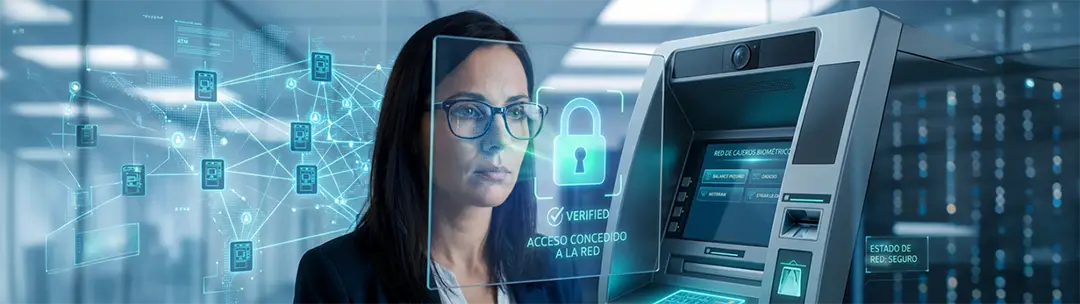
The procedure is simple: the user approaches the ATM, activates the facial recognition option, and the system verifies their identity against a pre-registered database. Once authentication is confirmed, the customer can proceed with their banking transaction.
In practice, however, this process requires a much broader technological architecture.
For authentication to work correctly, at least four layers of integration must be involved:
- ATM hardware, which must be capable of capturing an image of sufficient quality to perform biometric verification.
- Biometrics provider, responsible for comparing the captured face with the identities registered in its systems.
- Communication and integration infrastructure, which connects the ATM to biometric services and the bank’s systems.
- The ATM’s transactional platform, which continues the transaction flow once the customer’s identity has been confirmed.
Each of these elements must work in coordination to ensure a secure, fast, and seamless experience for the user.
Un desafío que va más allá del software
One of the first challenges that arises in these types of projects is the hardware. Although many ATMs include cameras, these do not always meet the technical requirements necessary for reliable facial recognition. In many cases, the solution involves integrating additional devices capable of capturing images with the resolution and quality required by biometric engines.
This is a clear example of how innovation in the ATM channel often requires coordination among hardware manufacturers, transactional platforms, biometric providers, and banking systems.
More than a single technology, facial biometrics at ATMs is the result of an integration ecosystem.
Innovating without losing sight of the user experience
As banks incorporate new technologies into their physical channels, an additional challenge arises: ensuring that these innovations improve the user experience without creating new barriers to access.
ATM modernization must take into account that the profile of those who use this channel is diverse. While some customers already interact primarily through mobile apps and biometric systems, others continue to use the ATM as their main point of contact with the bank.
In this context, the introduction of technologies such as facial biometrics also raises questions about accessibility and inclusion.
Some users may find it difficult to interact with these types of technologies, whether due to physical limitations, lighting conditions at the ATM, the use of accessories such as glasses or face masks, or simply a lack of familiarity with biometric processes.
For this reason, biometric implementations in self-service channels are typically designed around a key principle: technology should expand access options, not restrict them
This involves maintaining alternative authentication methods, designing clear interfaces that guide the user through the process, and accompanying the introduction of new features with education and communication strategies.
When implemented with this approach, biometrics not only strengthens system security but can also help create simpler, more natural, and more accessible experiences for a wide range of users.

The Path to the ATM of the Future
The integration of facial biometrics into ATM networks is part of a broader trend: the convergence between the digital world and the physical channels of the financial system.
As financial institutions seek to offer more secure and seamless experiences, authentication mechanisms are evolving toward models where the user’s identity becomes the primary factor for access.
In this context, facial biometrics is not the end goal, but rather one of the steps in a broader transformation of the ATM channel. A transformation that demands more than just technology: it requires architecture, integration among multiple stakeholders, and a clear vision of how financial services should evolve.
At CLAI PAYMENTS® Technologies, we understand that innovation in self-service channels requires much more than simply incorporating new technologies. The evolution of ATMs toward biometric authentication models demands flexible architectures, integration capabilities with multiple ecosystem stakeholders, and transactional platforms capable of adapting to new user interaction models. That is why we develop solutions like AZ7® that enable financial institutions to modernize their ATM networks in a secure, interoperable, and customer-centric manner.
If you would like to learn more about AZ7®, please provide your contact information below, and a specialist will contact you.